
Home › Medicare in Wisconsin › Milwaukee County
I talk to people in Wisconsin every week who’ve spent hours researching Medicare online — and most of what they found doesn’t even apply to their county. Medicare Advantage plans are approved at the county level, so the only numbers that matter to you are the Milwaukee County numbers. Here they are.
One client put it to me this way: “Retiring is not for the weak.” They weren’t talking about money — they were talking about the paperwork. The good news: the Medicare piece has an order to it, and once you see the order, the overwhelm drops fast.
Whether you’re in Bayside, Brown Deer, Cudahy, or anywhere else in Milwaukee County, the numbers below are yours — Medicare sets plan availability county-wide.
Medicare Advantage in Milwaukee County: the 2026 numbers
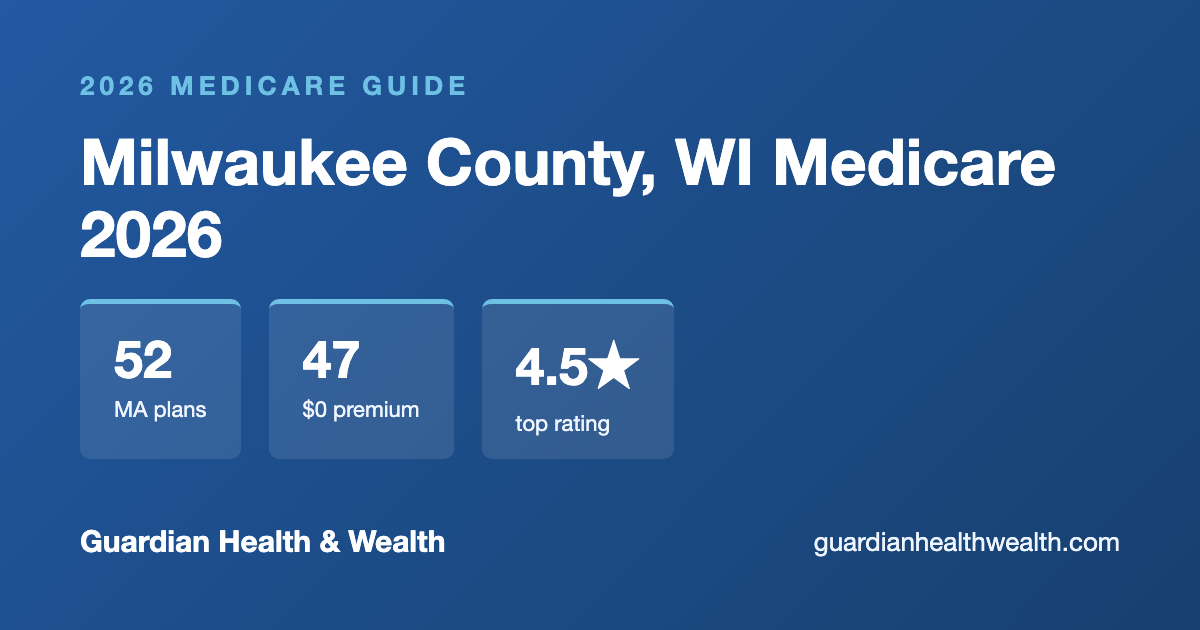
- 52 Medicare Advantage plans are approved in Milwaukee County for 2026.
- 47 of them have a $0 monthly premium.
- 8 different insurance organizations offer plans here, including UnitedHealthcare, Humana, Aetna Medicare, Network Health Medicare Advantage Plans.
- the highest 2026 overall CMS Star Rating in the county is 4.5 out of 5, and 26 plans are rated 4 out of 5 or higher.
- in-network out-of-pocket maximums range from $3,800 to $9,250, and premiums run from $0 to $73.80 per month.
- of the county’s 165,604 Medicare beneficiaries (CMS, 2026-March), 68% chose Medicare Advantage — the rest stayed on Original Medicare, most with a supplement and/or drug plan.
That’s a lot of choices — and that’s exactly the problem. More options doesn’t mean an easier decision. It usually means more ways to pick a plan that looks fine on paper and surprises you at the pharmacy counter.
HMO or PPO? What Milwaukee County actually offers
Of the 52 plans here, 23 are HMO-style and 27 are PPO-style. The difference matters more than most people realize. An HMO generally requires you to stay inside its network and often to get referrals — in exchange, costs are usually lower and more predictable. A PPO lets you see out-of-network doctors (at a higher cost), which matters if you split time between states, keep a specialist in another city, or just want the escape hatch.
The trap to avoid: choosing HMO vs. PPO by premium alone. A PPO that costs $30 more per month but keeps your out-of-state specialist in reach can be far cheaper than a zero-premium HMO that forces a new doctor and a new workup.
How the plans here rate
CMS scores every Medicare Advantage plan on a 5-star scale using member complaints, care quality, and customer service. In Milwaukee County, 26 of the 52 plans carry a 2026 overall Star Rating of 4 out of 5 or higher, and the highest rating available in the county is 4.5 out of 5. A strong rating is a good sign — but it can’t tell you whether your doctors are in a plan’s network or your prescriptions are on its formulary. That check is personal, and it’s the single most important step before enrolling.
To see how the plans in the county rate side by side, search the plans at your zip code — or bring us your doctor and prescription list and we’ll do the checking with you.
What “$0 premium” really means in Milwaukee County
“I got a bill for $19,000.” A real sentence from a real call — from someone whose plan looked fine until it wasn’t. This is why the out-of-pocket maximum matters more than the premium:
47 of the county’s 52 plans charge no monthly premium — and that’s the number the TV ads shout. Here’s the number they don’t: the maximum out-of-pocket. In Milwaukee County it runs from $3,800 to $9,250 per year, with a median of $6,000. That’s the amount you could actually be responsible for in a bad health year, and the spread between plans is thousands of dollars.
Drug deductibles are just as uneven: others charge up to $615 before drug coverage kicks in. Same county, same $0 premium — very different first trip to the pharmacy in January.
The Part B Give-Back in Milwaukee County
Here’s a benefit most people first hear about from a TV commercial and assume is a scam: some Medicare Advantage plans include a Part B premium reduction — lowering what you’re responsible for paying toward your Part B premium each month. It’s real. In Milwaukee County, 22 plans include a reduction in 2026, and the largest available here is $145 per month. How it shows up depends on how you pay your premium, and processing can take a few months to start.
A larger reduction doesn’t automatically make a plan the better choice — networks, drug coverage, and out-of-pocket limits differ plan to plan and can outweigh the monthly amount. Ask us which reductions apply to your situation, or see the plans at your zip code.
Who’s on Medicare in Milwaukee County
165,604 people in Milwaukee County are enrolled in Medicare as of CMS’s 2026 March Monthly Enrollment data; 111,917 of them (68%) chose a Medicare Advantage plan while 53,687 stayed on Original Medicare. That split matters: it tells you roughly how your neighbors weighed the same decision you’re making — though the right answer is personal, not popular.
40,292 county residents qualify for both Medicare and Medicaid. The county has 14 Dual-Eligible Special Needs Plans (D-SNPs) built specifically for that situation — often with benefits regular plans don’t include, and most people who qualify have no idea they exist.
Dental, vision, and hearing in Milwaukee County plans
Original Medicare covers none of these — which surprises almost everyone. Among Milwaukee County’s Medicare Advantage plans: 51 include dental benefits, 51 include vision, and 51 include hearing coverage. The fine print varies enormously — annual maximums, in-network dentist availability, and whether “dental” means cleanings only or actual crowns and dentures. If dental work is on your horizon, this comparison alone can be worth hundreds of dollars a year.
Stand-alone drug coverage (Part D) in Wisconsin
If you stay on Original Medicare — with or without a supplement — you’ll want a stand-alone Part D drug plan. Wisconsin has 10 PDPs for 2026. Premiums run from $0 to $113.90 per month (median $0), and 4 plans price at or below the regional benchmark — meaning people who qualify for Extra Help can get them for $0.
A pattern worth knowing: the cheapest Part D premiums usually pair with the highest deductibles. The only way to know which drug plan is actually cheapest for you is to price your exact prescription list against each plan — that’s precisely what we do on a consultation call, and it takes about ten minutes. Or run the comparison yourself at your zip code.
A Wisconsin rule worth knowing
Wisconsin uses its own standardized Medigap structure (a Basic plan plus riders) instead of the lettered plans used in most states.
When you can actually enroll
Availability means nothing if you miss your window. The three that matter for most people in Milwaukee County:
- Initial Enrollment Period — the 7 months around your 65th birthday (3 before your birthday month, your birthday month, 3 after). Missing it can mean permanent late-enrollment penalties on Part B and Part D.
- Annual Enrollment Period (Oct 15 – Dec 7) — when anyone can switch Medicare Advantage or Part D plans for the following year. This is when the plan numbers above get reshuffled — and when reviewing your plan against next year’s version actually pays.
- Still working past 65? If you have credible employer coverage, you may be able to delay Part B without penalty — but the rules are specific, and getting them wrong is one of the most expensive Medicare mistakes there is. This one is worth a conversation before your birthday, not after.
Questions people actually ask me — in their own words
“Can I start earlier?” Your Initial Enrollment Period opens 3 months before your 65th birthday month. Starting the homework 6 months out is the sweet spot — enough time to compare without deadline pressure.
“Even with Plan G?” Plan G covers most of what Original Medicare doesn’t — but it doesn’t include drug coverage, and it can’t be compared to an Advantage plan on premium alone. Different tools for different situations.
“Do I have to have Part B?” If you’re still working with credible employer coverage, maybe not yet — but the delay rules are specific, and getting them wrong triggers a lifetime penalty. This is the single most common question on my calls, and the answer is personal enough that I’d never answer it generically.
“I have trust issues.” Someone said that to me flat-out on a call once, and honestly — good. You should. This industry earns skepticism. It’s why every number on this page comes from the official CMS plan file rather than my opinion, and why a consultation with me starts with your situation, not a pitch.
Quick answers for Milwaukee County
Do all 52 plans include drug coverage? No — 43 of them do. If you pick one of the others, you generally cannot add a stand-alone drug plan on top of it, which surprises a lot of people.
Is the biggest carrier automatically the best here? No. UnitedHealthcare offers the most plans in Milwaukee County, but plan count isn’t quality — the right plan depends on your doctors, your pharmacy, and your prescriptions, and it’s often not from the biggest name on the list.
Can I get help without being sold something? Yes. A consultation with me is a conversation, not a pitch — we look at your doctors, your prescriptions, and your timeline, and you leave knowing exactly where you stand. If a plan change doesn’t make sense for you, I’ll tell you that too.
Where can I get local Medicare help in Milwaukee County? Right here — Guardian Health & Wealth works with Milwaukee County residents by phone or video at (270) 721-5069, so you get local guidance without leaving home. Consultations are free, and there’s never an obligation.
The towns of Milwaukee County
Everything on this page applies across the county — including Bayside, Brown Deer, Cudahy, Fox Point, Franklin, Glendale, Greendale, Greenfield, Hales Corners, Milwaukee, Oak Creek, River Hills, Shorewood, South Milwaukee, St. Francis, Wauwatosa, West Allis, West Milwaukee and Whitefish Bay — because Medicare plan availability is set at the county level.
We do not offer every plan available in your area. Currently we represent 5 organizations which offer 52 products in your area. Please contact Medicare.gov, 1-800-MEDICARE, or your local State Health Insurance Program (SHIP) to get information on all of your options.
See your Milwaukee County options in one page
I put the Milwaukee County plan landscape into a one-page snapshot: what’s available, what it costs, and the deadlines that apply to your situation — in plain English, specific to where you live.
Prefer to just talk it through? Schedule a free Medicare enrollment consultation — a one-on-one call about your specific doctors, prescriptions, and timeline. Or if you’d rather learn first, the free workshop walks through the decisions in order.
Ready to see actual plans side by side? Search and compare the plans available at your zip code — you can review details and even enroll directly online.
Getting to know Milwaukee County
Milwaukee County covers about 241 square miles of Wisconsin.
Most residents live in or around Bayside, with Brown Deer, Cudahy, Fox Point, Franklin, Glendale making up much of the rest. At about 687 Medicare beneficiaries per square mile it’s one of the more densely settled parts of Wisconsin, which usually means more provider choice inside a single plan’s network.
According to the CMS hospital registry, 13 Medicare-registered hospitals serve the county: Milwaukee Va Medical Center (Milwaukee); Ascension Columbia St Marys Hospital Milwaukee (Milwaukee); Ascension St Francis Hospital (Milwaukee); Ascension Se Wisconsin Hospital (Milwaukee); Aurora St Lukes Medical Center (Milwaukee); West Allis Memorial Hospital (West Allis). 9 operate emergency services.
Why this matters for Medicare: every Medicare Advantage plan has a network, and the same hospital can be in-network on one plan and out on another. Knowing which facilities serve Milwaukee County is step one; checking how the plan you’re considering treats them is step two — and it’s exactly the kind of thing we verify on a consultation call.
Health context matters to plan choice, too. CDC county data shows about 13% of Milwaukee County adults live with diabetes, 6% with coronary heart disease, and 7% with COPD. If you manage one of these conditions, it’s worth knowing the county has 2 Chronic-Condition Special Needs Plans — Medicare Advantage plans designed around specific conditions, with care coordination most standard plans don’t include. Whether one fits you is a network-and-medications question we can answer on a call.
The broader health picture from the same CDC dataset: 35% live with high blood pressure, 25% with arthritis, 24% with depression among Milwaukee County adults. These aren’t just statistics — they map directly to what matters in a plan: tier placement of blood-pressure and antidepressant medications, physical-therapy coverage, and whether your specialists are in network.
For longer-term care, Medicare’s Care Compare registry lists 32 certified nursing homes in the county: Clement Manor Health Care Center (Greenfield, 5-star CMS rating); Milwaukee Catholic Home (Milwaukee, 5-star CMS rating); Eastcastle Pl Bradford Ter Conv Ctr (Milwaukee, 4-star CMS rating); Milwaukee Health And Rehab (Milwaukee, 4-star CMS rating), plus 28 more. (Facility ratings are CMS’s own 5-star quality ratings — worth knowing about even if you hope never to need them, because Original Medicare and Advantage plans cover skilled nursing stays differently.)
The county is also served by 12 Medicare-certified hospice providers — hospice care is covered under Part A regardless of whether you choose Original Medicare or Medicare Advantage, one of the few benefits that works the same either way.
A wider lens from CMS’s Geographic Variation data: Medicare spent about $12,404 per beneficiary in Milwaukee County in 2024 (standardized, so it’s comparable across regions); local beneficiaries made about 762 emergency-room visits per 1,000 people; and 20% of hospital stays led to a readmission within 30 days. Numbers like these shape what care access and costs actually look like where you live — and they’re part of why the same national plan can perform differently county to county.
How Milwaukee County compares to the rest of Wisconsin
Averages hide the local picture, so here’s where Milwaukee County actually sits against the other 71 counties in Wisconsin: 68% of Milwaukee County beneficiaries are in Medicare Advantage, well above the Wisconsin median of 52%.
- Medicare spends $12,404 per beneficiary here — above the statewide median of $10,518.
- Emergency-room use runs well above the state median (762 visits per 1,000 beneficiaries vs. 631).
- You have 52 plans to choose from, well above the 36 a typical Wisconsin county sees.
Higher-than-average local spending usually reflects how much care people here actually use — which is exactly why the out-of-pocket maximum on a plan matters more in Milwaukee County than the monthly premium does.
Before you choose: the three questions that decide the rest
The plan counts above tell you what Milwaukee County has on the shelf. They do not tell you which shelf you should be shopping from. These three guides answer that, in the order the decision actually gets made:
What clients say




Written and reviewed by Michael Smith, licensed insurance broker, founder of Guardian Health & Wealth (Bowling Green, KY), and author of 64+: Your Ultimate Guide to Medicare & Retirement Planning.
We do not offer every plan available in your area. Currently we represent 5 organizations which offer 52 products in your area. Please contact Medicare.gov, 1-800-MEDICARE, or your local State Health Insurance Program (SHIP) to get information on all of your options.
Plan data: CMS CY2026 Landscape file (202607) and CMS 2026 Plan Benefit Package files, plan year 2026. Data last verified 2026-07-22. Figures are for Milwaukee County, Wisconsin and can change; always confirm details with the plan before enrolling. Star Ratings are the 2026 overall CMS ratings, measured on a 5-star scale.